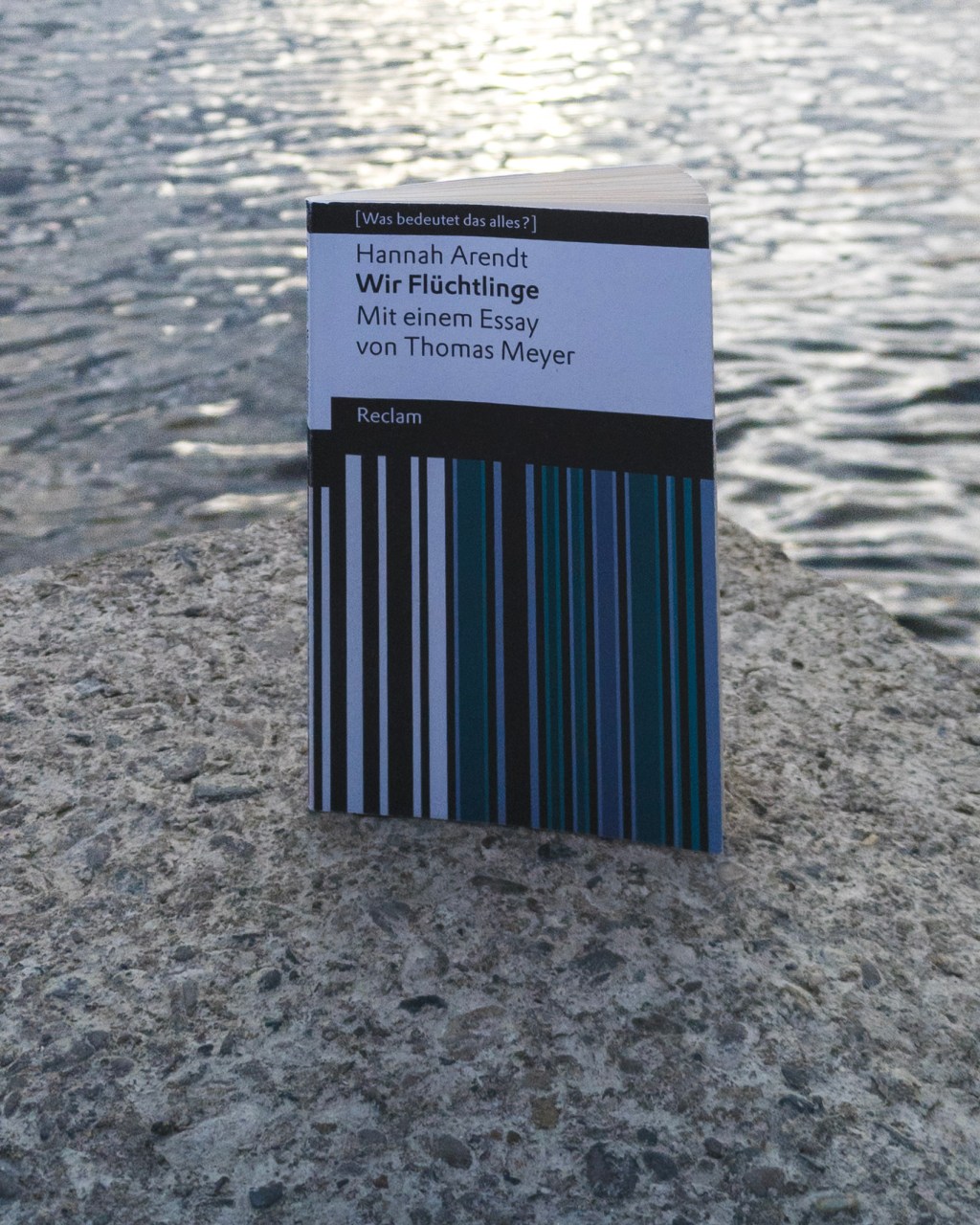
In her essay We Refugees (1943), written after her emigration first to France and then to the United States, Hannah Arendt explores the existential condition of refugees who not only lose their homeland but also their identity. She criticizes the expectation that refugees should assimilate and erase their past while also exposing how statelessness deprives individuals of their fundamental rights. Arendt’s work extends into a broader critique of the nation-state system, particularly its failure to protect those who fall outside its legal and political structures—a theme she would continue in later works.
I read a German edition (Reclam, 2016, trans. Eike Geisel) that includes an insightful essay by Thomas Meyer. He summarizes Arendt’s critique of the nation-state, as implied in We Refugees and developed further in her later writings Zionism Reconsidered and The Origins of Totalitarianism:
Es ging Arendt natürlich nicht darum, den in aller Welt zerstreuten Juden das Recht auf Sicherheit und eine neue Heimat abzusprechen. Vielmehr versuchte sie, ein Bewusstsein dafür zu schaffen, dass dafür zunächst das richtige politische Modell gewählt werden müsse, das nicht wieder das vollkommene Versagen von Nationalstaaten und Völkerbund erlebte, von denen keiner seine Bürger vor Übergriffen von Feinden schützen konnte.
(Arendt was, of course, not denying the dispersed Jews around the world the right to security and a new homeland. Rather, she sought to raise awareness that this required choosing the right political model—one that would not once again witness the complete failure of nation-states and the League of Nations, neither of which had been able to protect their citizens from attacks by their enemies.) My translation
Arendt’s warnings about the failures of the nation-state are frighteningly relevant today. From Russia’s war in Ukraine to ongoing violence in the Middle East, from the rise of competitive authoritarianism and oligarchy in the West to the inability to address climate change and economic inequality: an increasing number of people are no longer protected by “their” nation-state. The post-war liberal state is under pressure both from within and without, challenged by political leaders, extremists, oligarchs, and extra-parliamentary opposition. If these trends continue unchecked, this erosion of the nation-state may be purely destructive—devoid of the constructive hope that Arendt, at times, still envisioned.

Thoughts?